


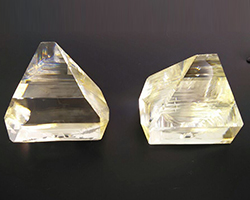
KTP crystal is the most commonly used for SHG(Frequency doubling) of Nd-doped laser for green/red output. It is widely used in laboratory and medical systems, range-finders, lidar, optical communication and industrial systems.

Advantages:
1. Large nonlinear optical coefficient
2. High electro-optic coefficient and low dielectric constant
3. High thermal conductivity
4. Moisture free, chemically and mechanically stable
5. Large figure of merit
6. High electro-optic coefficient and low dielectric constant
Applications:
1. Second harmonic generator of radiation 1.064 μm
2. Optical parametric oscilator in near IR region up to 4 μm
3. Different frequency generator in near IR region
4. E-O Modulators, Optical Switches, Directional Couplers
|
|
Orthorhombic, space group Pna21,point group mm2 |
| Cell parameters | a=6.404Å, b=10.616Å, c=12.814Å, Z=8 |
| Melting point | 1172ã¡C incongruent |
| Curie point | 936°C |
| Mohs hardness | ~5 |
| Density | 3.01 g/cm3 |
| Color | colorless |
| Hygroscopic susceptibility | no |
| Specific heat | 0.1643 cal/g°C |
| Thermal conductivity | 0.13 W/cm/°K |
| Electrical conductivity | 3.5x10⁻⁸ s/cm (c-axis, 22°C, 1KHz) |
| Dimension Tolerance | W(+/-0.1) x H(+/-0.1) x L(+0.5/-0.1)mm |
| Angle Tolerance | +/-0.25° |
| Perpendicularity | ≤10′ |
| Scratch/Dig | 20/10 |
| Chamfer | ≤0.2mmx45° |
| Parallelism | ≤10″ |
| Chips | ≤0.1mm |
| Flatness | λ/10@633nm |
| Clear Aperture | ≥90% |
| Wavefront distortion | λ/8@633nm |
| Coatings | AR@1064(R
<0.2%)&532(R<0.5%) HR@1064(R>99.8%)&HT@532(T>95%) |
| Damage Threshold | 500MW/cm2 (1064nm, 10ns, 1Hz) |
A KTP (Potassium Titanyl Phosphate, KTiOPO₄) crystal is a nonlinear optical material widely used to change the frequency of laser light.
KTP crystals have relatively high nonlinear optical coefficients, wide angular and temperature acceptance, and are non-hygroscopic with good mechanical and chemical stability.
The typical application of KTP crystals is performing second harmonic generation (SHG) on 1064 nm fundamental light by Nd-doped lasers, such as Nd:YAG and Nd:YVO₄, to produce green light at 532 nm.
While the laser crystal is responsible for the fundamental laser output, the KTP crystal can change the wavelength and frequency of laser light using nonlinear optical effects.
For example, the common 532 nm green laser, with Nd:YAG or Nd:YVO₄ crystals, first generates 1064 nm near-infrared laser light. The KTP crystal then converts part of the 1064 nm fundamental light into 532 nm green light.
Apart from the KTP material, the conversion efficiency is also affected by crystal cut angle, effective length, temperature, beam quality, polarization direction, power density, coating loss and cavity configuration. Therefore, KTP crystals should be selected according to the specific laser system.

 English
 Deutsch
 Русский